Who picks up when a remote consultation stops?
How to hand over a remote appointment when the next step needs a different person or service.
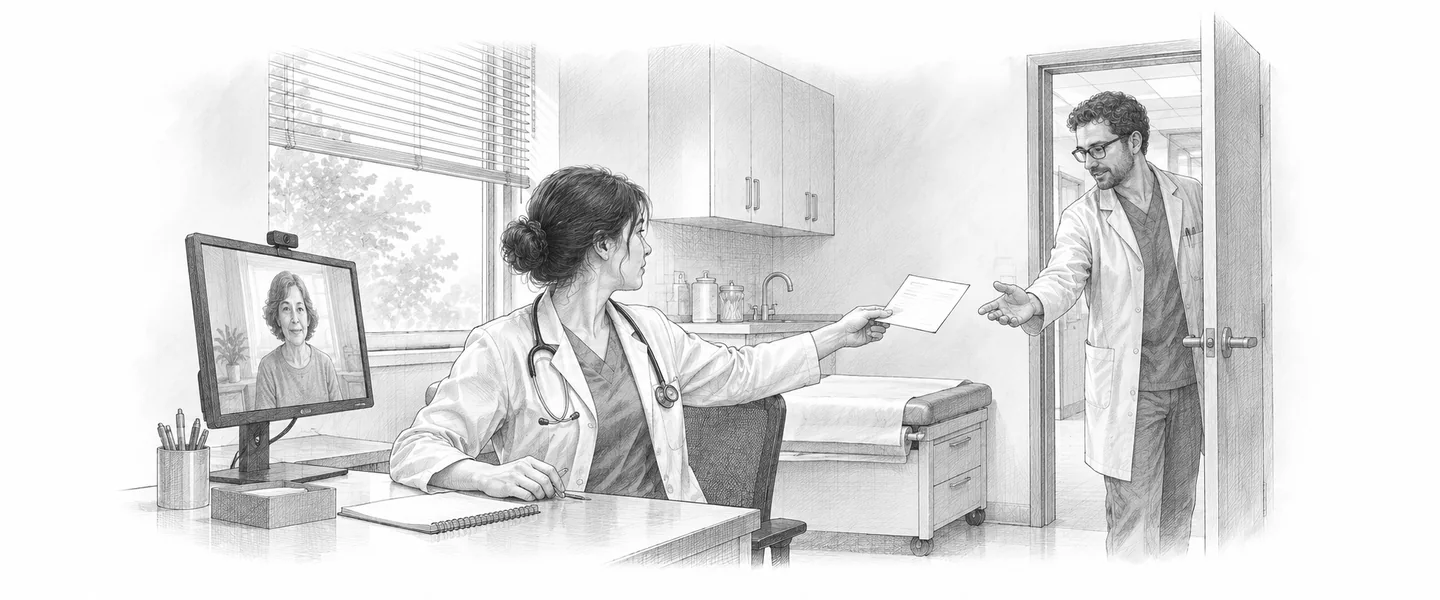
Imagine a community organisation lends a private room to a remote health service. An interpreter joins, the connection drops and the appointment disappears from the laptop. The person who set up the call can see that it lasted eleven minutes. They can't see whether the clinician finished, whether there was anything still to arrange, or whether they should ask the patient to wait. A room booking and a completed call leave the same mark on the room's calendar.
On 31 July Colombia's health ministry signed Resolution 1644, setting conditions for telehealth activities and telemedicine. The ministry's subsequent explanation distinguishes activities such as remote guidance from clinical telemedicine and describes categories with different modes of communication and professional responsibilities. It also describes a telemedicine connection point intended particularly for communities that are rural, dispersed or hard to reach, with minimum infrastructure and connectivity conditions. That connection point makes it worth asking what a local team can do when it has the room but someone elsewhere has the clinical responsibility. Signed resolution · Health ministry bulletin 113
Agree what happens in each room
If your organisation is lending a room, work through an appointment with the health provider and agree the boundaries before people start using it. The local worker might open the room, check that the right interpreter can join the call and show the person how to summon help. The provider needs to set its own rules about clinical identity checks, consent and records. Give the two sides a way to confirm when an appointment can start without copying clinical information into a room booking or asking the local worker to make decisions they aren't trained to make.
Think through the handover from the worker to the clinician. In our example a member of staff might be asked to stay in the room while the interpreter connects. Decide who asks the patient if they want that person present and what the worker can see on the shared computer. A small detail such as who faces the door can change whether the person needs to speak across a room where someone outside could hear. Try it from the patient's chair and arrange the room accordingly.
Let local staff distinguish an introduction, an in-progress appointment and a consultation the clinician has said is complete. This can be a status visible in an agreed place, or a confirmation from a named role through an agreed channel. Scope it to the things the room staff need to do. The appointment can need further action while the patient is perfectly free to leave, and somebody should be able to tell them that without handing the room worker access to clinical notes.
Plan for two different accounts of a dropped call
Suppose the connection fails at both ends. The clinician thinks the patient hung up, and the person in the room thinks they are being called back. A recovery procedure should say who tries to re-establish contact and how long the local worker waits before following up. If a provider permits a switch to a phone call, confirm who initiates it and on which number. If the team has to rebook, agree who tells the patient and how the clinician marks the original encounter, particularly if some of it took place.
Try a second case where the technology is behaving and the person cannot continue the call in private. Perhaps a shared room becomes unavailable unexpectedly. The local worker needs a contact who can deal with the interruption and can offer whatever alternatives the provider has agreed. Put that contact where a shift worker can find it while the video system is unavailable. A web page behind the video system's login is an inconvenient place to keep instructions for when the login itself fails.
Agree what the patient will have in their hands when they leave. Someone who came to use the room because they can't take a private call at home may have the same problem if the clinician rings back later. In a dummy case, arrange for the person to ask for another time or another private place, then see whether the provider's team can see that request when it makes the callback. If they hand out a printed appointment slip, the room staff should know which details the provider has agreed can appear on it.
The room may be available on different days from the provider. Let the person rebooking see those differences before they offer a slot. A slot that is free on the clinical calendar can still be unusable if the person needs the local room and nobody is there to open it. That issue belongs with the staff keeping the two calendars in step.
Work out where to record the interruption. The room team might record when it lost the call and when a provider contacted it, with a reference the provider can recognise. The clinician can record the status and next clinical action in the system the provider uses for that purpose. If staff reconcile the two, they need a way to follow up mismatches through the permitted channel. Give them a test record where the two accounts initially differ. The exercise ends when somebody can explain the next action to the patient.
See what can work without a live appointment
The ministry describes both live and asynchronous communication in its account of the telemedicine categories. If a service lets people do part of the work at different times, someone still has to accept and act on what arrives. Health ministry bulletin, telemedicine categories In a hypothetical service, one provider might ask another for advice and wait for a response. The work list needs to show who is expected to pick it up and what the referring team does if that reply doesn't come. An acknowledgement that files arrived tells the referring team very little about when an accountable person will look at them.
If you take over an existing arrangement, invite the provider to run a brief rehearsal with a dummy appointment and the people who will actually open the room. Include the interpreter or other agreed support where relevant. Start with an ordinary connection and then stop halfway through. Ask the local worker what they would tell the person in the room at that minute. If their instruction relies on recognising the usual clinician's personal number, take the exercise far enough to get an agreed route that staff can use on a different day.
Before the room goes live, close the laptop and test the phone route. The provider nominates the role that picks up an interrupted case, and the person opening the building can reach it from the room with the laptop closed. If the plan includes a call back, the provider can show in a test that it reaches the place or device the patient agreed to use after leaving.